Showing posts with label gencon. Show all posts

02 September 2015

GenCon with Geeklets, Part 2 (Infants and Toddlers)

This is part 2 in a series of posts about navigating GenCon with geek kids. Part 1 (General Advice) is here.

Infants and Toddlers:
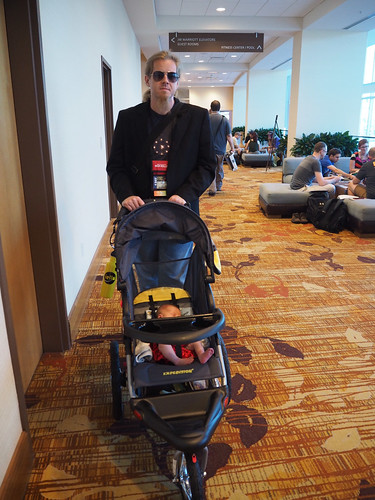
Big stroller. Tiny baby. Stark casual.

Practically speaking, small babies are pretty easy to manage in a con environment. You should plan to bring child-wearing gear, or the smallest stroller that you can manage. If you intend to take a stroller into the dealer's hall then please be aware of the footprint -- our jogging stroller is pretty substantial and we definitely found parking it on the edges of booths for browsing purposes problematic at times. Bigger booths with internal space were much less trouble. People are overall very aware of their space and we didn't really run into trouble with tripping or collisions. People are also very polite and did not give us mean looks or snide comments to our faces, and in return we tried to be as polite and careful as we could be.

Toddlers are a full-time job, and you should probably plan to have someone who can devote their attention full-time to child monitoring at all times. You would not believe how quickly a toddler can get lost in a crowded dealer's hall, when you just stopped for a moment to look at that game demo. For your toddler, you will still want to bring a stroller (again, small footprint please) or your child-wearing gear of choice, because you will be doing a lot of carrying. The convention hall is big. Really big. You are going to wish you had a grownup to carry you sometimes.
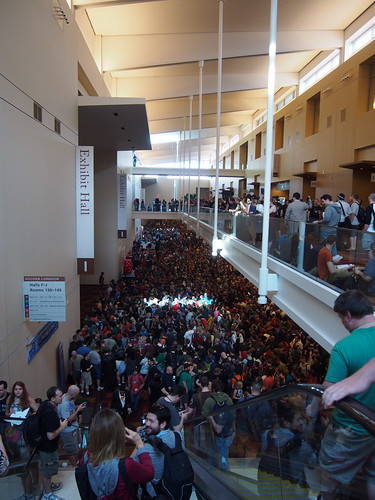
Really really busy.

The convention is busy. It is loud. It is full of sudden colors and intense stimuli. Your primary responsibility is going to have to be to your littles -- be aware of their responses to their environment, especially in the dealer's hall, and be prepared to get out if need be. Pax had no trouble with the noise and chaos of the dealer hall, but Cap'n's first trip was a little more stressful. He got overwhelmed at times and was just at the starting-to-walk phase so he wanted to be down and exploring frequently. We spent quite a bit of time that year at the Family Fun pavilion, which is located at the back of the 100 section of the dealer hall, and the surrounding booths and demos.

The kids waited in line just for this stuff.

Feeding:

I'm on my third child and by this point I frankly don't give a hoot about whether people's sensibilities are offended by breastfeeeding in public, but not everyone (or their babies) is at that place. This year Family Fun introduced a crawlers space and a private nursing area, which had two chairs with arms and was a real blessing; additionally one of the convention hall women's bathrooms apparently had their powder room space set up for private nursing space (I never found it but I was told it was quite nice). It's a pretty substantial walk to the back of the dealer's hall (pro tip: they usually have an open entrance along the Capitol Ave hallway that's less crowded and a LOT closer to the Family Fun pavilion) and I'm lazy, so I also took an inflatable My Brest Friend nursing pillow (I saw a lot of travel Boppy pillows too) and a cover and just grabbed whatever space was available in hotel lobbies or the chairs along the concourse to feed Pax. Nobody gave me any trouble, and I had some great conversations as well.

Also Donuts.

For older infants: Bring baby food or a grinder if you are going to need them -- there is a pretty limited store selection in the near vicinity, and the food trucks do not cater to the bland and mushy palate. If you need a fridge in your hotel room, ask the hotel in advance. Frequently these are provided, but we have had years where there were no fridges or a waiting list 1-2 days long for fridges. If it's extremely important (breast milk supplies, special dietary needs) then you may consider bringing your own cooler for emergencies.

This is covered in more detail in the General Advice post, but if the food trucks are not an option for your toddler, there are some bistro-style cafes in the convention center and Circle Center does have a food court. Most of the restaurants near the convention center also provide a kids' menu, so your picky eater will have eating options. However, lines are long in the surrounding few blocks so you will need to plan your restaurant ahead. Pack snacks.

Baby-Specific Needs:

We have yet to find a bathroom -- men's or women's -- in the Indianapolis Convention Center that has a changing table. Be aware. The surrounding hotels do have some changing tables, including in the men's rooms, but not all hotels and not all bathrooms are so equipped. Bring a changing pad and be ready to do diapers in a down and dirty fashion.

For emergency supply needs you may be able to get some things from your hotel's front desk, but if not then the closest pharmacy is the CVS on Ohio Street, approximately 3/4 of a mile walk away. They carry a sufficient selection of baby and nursing supplies and the staff are very nice. It's not a 24 hour store so check the hours before you go late at night. Circle Center Mall has children's clothing but is pretty upscale so does not carry basic necessities that I'm aware of.
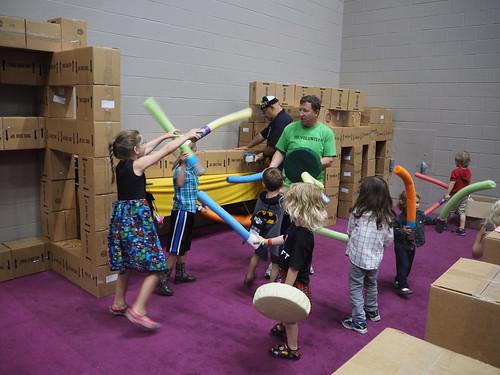
Family Fun Noodle Fight

Entertainment:

If you do cosplay, we cannot recommend Baby Yoda highly enough. We've done several variants on this costume (this year Etsy provided a crocheted Yoda hat) and it's quick, easy, extremely recognizable, and eminently washable. Also for older babies Luke Skywalker's Dagobah outfit is basically a beat-up white tank top and some cargo pants, and you can carry Baby Yoda in a backpack to complete the set.

Cosplay Baby!

If you're a little craftier, I took some pre-con time with my embroidery machine (you could economize and buy patches too) and did some baby costumes based off of a Simplicity baby dress pattern. They were a huge hit and Pax got a lot of compliments. Everyone loves a geek baby.

As far as doing activities, we had good luck with the CCG hall and game demos; parking the stroller next to the game space was no problem for larger booths or playspaces like Iello's demo room. Over-18 and over-21 activities generally will not permit even infants in, which I find to be a point of respect for the other attendees and we did not try to take Pax to see the Glitter Guild. Concerts are often pretty tightly seated but you can put a stroller in the back of the room and sit with it there or lap-sit your baby; we have taken the littles to see Marc Gunn play in previous years (I recommend the Cat Lovers show) and that's gone well when they're not overtired.
As far as playing in scheduled games, most convention games are on a time-restricted schedule and often players are booked back to back. If your baby is going to require attention and take your focus away from the game (hint: most babies will not reliably schedule a two-hour nap during your game slot) then you should have someone who can care for them during the game. If you don't have someone, then ask your GM in advance (if possible) how they feel about having the distraction. Then ask the other players. Be prepared to bow out if your child is going to negatively impact others' con gaming experience. As a GM, I've seen distracted players sometimes pull down the whole run, while other groups are able to work around them much more flexibly. Playing with strangers is an adventure in itself.

Strollers are not welcome in True Dungeon, nor would I recommend trying to bring a carried infant into the space. It's dark, it's loud, things move around and there are lots of surprises. Signing a waiver is probably your cue that this is not a baby-friendly activity, if you make it that far. Get a baby-watcher and have yourself some adult fun, if True Dungeon is your thing.


...next up: Part Three: Big Kid Activities...


25 January 2015

Pregnant Cosplay

So we made a tactical error and it appears I'm going to be due on the first day of GenCon 2015. I blame GenCon for being almost 2 weeks earlier than usual, but it's not that far from home to the convention and the kids are going to be out of school and able to attend all four days, so we don't want to write the con off, so we're currently counting on the fact that my babies have to be forcibly evicted from my body rather than coming on schedule.

In other words, we booked a hotel room for GenCon today, muaha.

The problem is cosplay: I have a lot of neat ideas for cosplay costumes including having the kids team up with cosplay buddies for Magic Knights Rayearth, putting my spouse in blue spandex for a gender-swapped Mystique and Magneto (this one had great potential for nursing adaptations), the Incredibles (with modifications for the whole Spandex thing); and dressing the baby up as a small mongrel dog and going as Dorothy. But none of those are particularly amenable to a 40-week pregnant belly.

Enter the Internet. Exclude immediately any scene from Alien.

I've been doing some research, and since I'm not about to pick up an anime series just to find out about a pregnant character, we've narrowed the field to several choices: Amy and Rory from the Doctor Who episode "Amy's Choice" (very casual and requires only regular clothing); the Death Star (I have seen this done quite well and I'm sure the spouse could be some kind of pilot); or the current front runner: Padme and Anakin Skywalker, from Revenge of the Sith.

Did you know it's sort of tricky to find pregnant women in prominent roles in sci-fi and fantasy movies? They are mostly shown being stuffed into refrigerators dying in childbirth.

Padme, on the other hand, gets to negotiate an entire movie of being pregnant before she goes the refrigerator route, and her wardrobe ranges from the action-hero Mustafar "sleeveless" dress (leather cross-bracing around the breasts makes it probably a no-go for me, as Boobzilla does not need any highlighting) to the giant black velvet cape (not in August, not at GenCon) to the fantastic embroidered green velvet "at home" number (pretty, very pretty, and probably too complex to fit to my changing body). It also includes several simple drapey nightgowns, which I am eyeing right now and attempting to decide whether I want to modify the Veranda nightdress to include straps (this will involve some new stitching or embroidery techniques and about 10 yards of silk satin) or mock up the embroidery patterns along the edges of the aqua georgette.

I'm really eying the georgette because I think it's super pretty and I like the sleeves better. The spouse likes the idea of dressing in full Jedi leathers and acting moody, and if we're going to do a prequel cosplay then I suppose Revenge of the Sith is not the worst one to do.

The entertaining part of this was when Cups came in on the discussion. "Are we going to do Star Wars? Can I be Princess Leia?" Followed by Cap'n an hour later: "Can I be Luke Skywalker?"

Yes, kids. Yes, you can. As creepy as it is, that's totally appropriate for you to be.

I'm going to have to start working on this soon. I'd better make up my mind.


19 August 2013

With Great Power…

Friday morning at Games on Demand, I’m sorting dice out for a round of Hollowpoint and my first two players sit down.  They’re a couple, looking fresh and well rested.  There’s a Star Wars T-shirt involved. I give them my great big GM grin and say “Hi! Here for Hollowpoint?” 

“We sure are,” one of them says.

“We’ve never done this before,”  the other one says.

“Never played Hollowpoint?”  Most of my players have never played Hollowpoint, although some of them have read the book; occasionally a whole table or most of a table has read the book and that is what led yesterday to a demand to “Play it straight, like maybe Cold War era?”  and some frantic Wikipedia searching before running an impromptu setting of Berlin: 1988 in which the E Street Band was rescued from the Russians.

( I love my players very much for bearing with me when I did not know off the top of my head that a Sig Sauer was a Swiss gun and entirely inappropriate for the KGB, and thank you to the substitution of a Makarov.  You are what makes this game worth running. )

“We’ve never played an RPG at all,” he says.

“We’re tabletop virgins,” she says.   They’re both wearing smiles on their faces and they look excited and they are sitting at my Hollowpoint table and inside my mind the Imposter Syndrome reel started running a countdown.  Cue the sound of an LP going in reverse. 

Holy shit these folks are sitting at my table and they’ve never played a roleplaying game before and they want to play Hollowpoint.  What are they going to thinkI almost asked them if they were sure they wanted to start here.  Now.  On Friday morning with me.  On this particular game.  Maybe they should grab a GM who was good at explaining things.

And then I took a deep breath and told the Imposter Syndrome reel to Fuck You.  And what I said was “You’re going to need some dice.  About 5-10 six siders.  I’ve got loaners if you need them.  And a pencil.  Which I also have if you need one.”

They needed dice.  I handed them a couple little boxes of spare dice.  He complimented my dice.  I complimented her shirt.  We made small talk – they’re getting married soon and want to put some geekery in it; my sister in law made edible D6’s for my daughter’s birthday cake out of gummi bears which was awesome – and the table filled up around us.

I handed out place cards.  I asked if anyone had played Hollowpoint.  Nobody had.   I introduced the gaming newbies.  I gave the ten-second talk on what roleplaying games are ("When we were kids, we played games with other kids.  I said ‘I shoot you’ and you said ‘No you didn’t, you missed’.  Now we have dice to help us decide who misses).  I said “I will be helpful.  I want you to understand this game.  I will not be gentle.  My job is to attempt to kill you.  Repeatedly.  Please don’t hesitate to ask for help.”

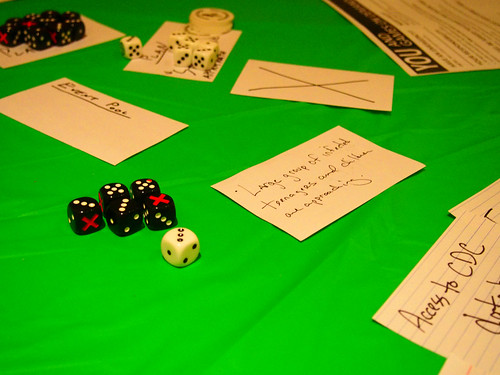
Everyone laughed.   I brought out the X-card as part of the introduction to Hollowpoint: “This is a game about doing bad things.  There will be blood.  There will be moral bankruptcy.  There will be violent.  If something is getting too intense or killing your action movie buzz, or if you just really hate spiders and the game isn’t fun with spiders, this is an X-card.  Tap it or lift it, draw our attention to it.  We’ll take out the spiders and go around the problem, no questions asked.”  No big deal.  No pressure at all.  Fuck you, That Girl GM Syndrome. 

I didn’t play it, but I brought it up again in character creation: “If you ask me ‘Hey Nykki, do we have pineapple grenades?’ I will say ‘I don’t know, do you have pineapple grenades?’  If you ask me ‘Hey Nykki, do we have flying dragons?’ I will X-card you.”  Everyone laughed.

I threw out a handful of settings, including last year’s Film Noir – Magic Kingdom, and that’s what they voted to play.  I had a brief flash of Imposter Syndrome at that as well – here you are, and your first con game ever is a dark humor setup about a bloodbath in Disneyland – and then I remembered how well it had gone last year.  How well it always goes. 

I have my Hollowpoint con game down to a pretty solid 90-minute run: I can add or subtract encounters as need be on the fly, but normally we get in four encounters and some skill checks, as well as some solid roleplaying, and hit the Principal scene at the 30 minute light flashing.  The newbies, as Steve Segedy so aptly predicted during our warmup, were fantastic.  It took them only a few minutes to get into the swing of things, and by the time Tinkerbell ditched them at a mud puddle in the woods (“Youse guys, you get inna throne room, you say ‘Bibbidi Bobbidi Boo’, I’ll be there.  Bam.  I’ll get you the money.”) there was no stopping them.

We ended on time.  Everyone was laughing.  Ink was flowing (what, you expected blood from a Toon?) and the Magic Kingdom was saved.   We wrapped up (“That’s Hollowpoint, everyone, at the IPR booth #1310 in the exhibit hall along with Many Other Awesome Indie Games) and I made sure to tell the newbies to come back and play something else.  Try them all! 

“We’ll be back,” she said. 

“Sure thing,” he said. 

It was a great game.  I hope they came back. I didn’t get your names, anonymous couple who used the color of your markers for your character names and started a trend that went around the whole table, but thank you.  Seriously.   Because you made my GenCon a little more awesome. 

02 August 2013

The X-Card

There's this really awesome idea that I first heard about from an interview with +John Stavropoulos: the X-card.

His explanation is probably the best, so I'll link to it (linky!) and just summarize it here: The X-card is left on the table as a go-to place for anyone in the game to use when content makes them uncomfortable. You just tap or lift the card, the group edits the content to get past or around whatever is problematic, and the game moves forward. John even includes a pretty awesome little intro speech (with choreography!) that you can use to introduce the X-cards into your game.

This year, for GenCon, I am saying a great big "I can't hear you" to my Imposter syndrome and volunteering as a GM for Games on Demand once again. I'm going to be offering two games: +Brad Murray and +C. W. Marshall's spectacular Hollowpoint, which is a game about bad people killing bad people for bad reasons, and Magpie Games' Our Last Best Hope, which is a game about classic disaster movies, focusing on personal sacrifice in the face of overwhelming odds.

These are games (like every other roleplaying game I've ever played) that have the potential to take a hard ninety-degree turn into the darkness. These are games where having an X-card is not only potentially beneficial but where it might be almost a necessity. I have GM'd Hollowpoint with strangers before -- last year at GenCon -- with men and women and one older teenager with his parents. I didn't know about X-cards, but I knew about checking in with the table in advance, asking about language and "grown-up themes" and trying to watch my players. Even then, I encountered situations where I wasn't sure if we were still telling a story or if we were just trying to see who blinked first.

The problem is this: I'm a woman running a hyper-violent roleplaying game at a major gaming convention. (One day, I was a woman in a Buttercup costume running a hyper-violent roleplaying game at a major gaming convention). I'm constantly concerned that if I mess this game up, it's not going to be because I made a mistake: it's going to be because I'm a Girl GM.

Yeah, this is that post about being a woman in a traditionally male-dominated enterprise. It's about feeling like I'm not representing just me -- because, really, nobody is going to remember my name if I screw up one two-hour gaming session -- but they're going to remember that That Girl GM couldn't keep her NPCs straight. They're going to remember that That Girl GM failed to deliver two hours of rollercoaster entertainment. And they're going to remember that That Girl GM threw the X-card.

You see, John suggests that as the GM, you close out with “…and usually I’m the one who ends up using the X card to protect myself from you all!” and follow up by throwing the X-card on yourself early on. If it gets gory, or scary, or whatever, you laugh, and X-card yourself, to show it's no big deal.

I'm totally behind this concept -- as the GM, it's my responsibility to set the bar. When I GM a game I'm going to influence its tone, its pacing, and the direction of the plot -- even in GM-less games like Our Last Best Hope it's my table, and that means something. I want everyone to be comfortable, and have an awesome time, and go away telling stories about all of the amazing things that happened at Nykki B's table.

But when I'm throwing an X-card I'm afraid I'm not going to be Nykki B. I'm going to be Nykki B That Girl GM who couldn't cut it. And that's exactly what I'm supposed to be preventing by setting the example, aren't I? I'm supposed to be the one who makes it no big deal. And John, he's awesome, but he's never going to be That Girl GM, and I don't know if I can explain what it feels like, being aware that what I do isn't just about me.

It's just a con. It's a really big con that sells out the entire downtown hotel block of a major midwestern capital city, but it's just a con. And I'm just a GM and a woman and a gamer and a geek, and I'm not responsible for shouldering the entire con experience of women in gaming.

So yes I am going to bring the X-cards and I'm going to copy down all of John's awesome speech about using them, even the bit about protecting myself from my players, because fuck you imposter syndrome I am a good GM and I owe the best game I can possibly run to my players.

And I run a damn good game of Hollowpoint. Even if sometimes it means I blink first.

27 August 2012

A Confession about GenCon

This year, as Nykki mentioned in her previous post, we decided relatively last-minute to be GMs at Games on Demand through Indie Games Explosion.. Thursday night, I got there late because I was being chauffeur for our youngest, missing my scheduled block. I helped at the table for about an hour and then ran a session of Hollowpoint at 8.

The next day, we got there for our 10 am sessions after running the youngest back to daycare. There's a line already out the door by the time we're there. I sorted out our prep materials when I heard Nykki calling over to me asking if I'm up for running Dungeon World. I said sure, as apparently there were already multiple tables for it filling up. I grabbed my materials and head over to my assigned table, diving right into a game. I ended up running it for the rest of my sessions at GenCon.

I loved how easily Dungeon World runs. I have played and run Dungeons and Dragons since high school in its various incarnations (2nd ed, Skills and Powers, 3.0, 3.5, 4.0, Pathfinder). I have a lot of experience in the genre, which I'm sure helped me out. Even so, the system and its inclusion of the players in the creation of the world really opened up new ways of playing. I have become enamored. That said, I have something of a confession to make.

Before my 10 am Friday session at GenCon, I had never run or played in a Dungeon World game.

Even finding the system is a bit of a set of random circumstances. It all started from Nykki's Kickstarter trawling. To be fair, I don't think she just randomly searched for Kickstarters to back, yet there have been a number of them that I have no idea how she found. Sometime in the last year or so, we backed Monsterhearts. It's a RPG/story game about monsters in high school using the system from Apocalypse World. I think it was the setting that got us to back Monsterhearts, originally. The Kickstarter had finished, we'd gotten the softcover, and it was put up on the shelf with other small-publisher RPGs, likely to be read when one of us had the time.

I am a PhD student. This leaves me with virtually no time for extra reading during the fall and spring semesters, but my summers are far less structured. At some point this summer, I decided to take a break from academic reading and pulled down some of the games. It took one read through of Monsterhearts and I was sold on the system. The group character gen, the far more spontaneous GM'ing, the ability for players to interact with the world in ways not done in D&D/Pathfinder; all of these fascinated me. However, we don't exactly have a very regular gaming group, so play-testing was likely not very likely. I put it on the list of games to run at the annual New Year's gaming party we go to, which is where we usually break in small-publisher systems.

Meanwhile, several of the gamers in my G+ stream had been pushing this Kickstarter for Dungeon World. All I had seen on it was that it was "old school style and modern rules," but hadn't really explored what this "modern system" was. After I had read the Monsterhearts book and poked around a bit with the Apocalypse World site, one of these Dungeon World posts wandered by and something clicked in my head. I went poking around the Dungeon World site. Oh, it's that system, my brain thought. Boom. Kickstartered. And I started trolling the Dungeon World forums (discovering the dozens of different hacks out there).

I had no idea how many games I might be called upon to run at GenCon, so I started prepping something in every system I had that wasn't 4.0 or Pathfinder: Hollowpoint, Homcidal Transients, Hollow Earth, Monsterhearts. Dungeon World was on the list I planned to prep, but I didn't have much of a scenario in mind (which is OK, since the book tells me not to prep too much for the first session). But I still hadn't played it or Monsterhearts.

One night, the week before GenCon, our online weekly group offered to hold off on running our actual Pathfinder Adventure Path and I could run something. We ended up with Monsterhearts. I got them through character creation and about an hour or so of them role-playing home room before it was time for several of us to go to bed, due to it being Thursday night. But, I had a lot of good feedback on teaching the system and character creation (mostly: pre-gen them), so I thought I had a handle on the game/system.

And then it was GenCon.

The players were all awesome. The groups worked well together. The biggest problem I ran into was keeping track of 6 players when there were 11 other tables running in the same room. (Which means that the biggest problem was the success of Games on Demand, so I'm not really complaining here.) There was such demand for Dungeon World that I would finish one game and I'd have a new table waiting in the wings. The system drew the players in very early in and there was very minimal need to explain the rules. The players very quickly got interested in what was going on, which in turn got me even more invested in the game. I'm glad I could get some exposure for this great game out into the gaming world. I am very pleased with the game and am eagerly awaiting the actual finalized book/pdf to show up.

25 August 2012

GenCon 2012: Nykki GM’s with GoD

I don't remember who started it.  

Either Angel or I at some point said "Hey, why don't we run some games at GenCon this year with Indie Games on Demand?"  And the other person said "Sure, that sounds like fun."  So we emailed the Games on Demand folks (who are awesome), and after some back and forth we were given the opportunity to trade up to GM badges for running just 7 2-hour sessions each.   In a fit of "We've got two whole days without the kids" we said sure, why not

About twenty-four hours later I realized that I'd just signed up to spend fourteen hours running games for people I'd never met before at a Gaming Con, and I nearly had a nervous breakdown.  But I'd said I would do it, and I'm always super excited about running Hollowpoint, and I had a pretty good handle on Homicidal Transients (it's not a complicated system), so I buckled down and got to work dreaming up some scenarios that I thought I could play out in ninety minutes (reserving half an hour for character generation, rules explanation, and getting people rounded up).  And all the while the imposter syndrome reel was playing out in my head: What makes you think you're going to be any good at this?  You’re not ready to deal with the jerk players who try to break things. Your narrative is going to fall flat.  Do you really know the rules that well?

I've been playing RPG's since I was rather awkwardly introduced to the concept with a D&D 2e Skills and Powers campaign in college (I was the awkward one), playing a twinked-out bow ranger with a pacifist hangup.  I've run D&D from second ed through fourth and abandoned it for Pathfinder in mid-campaign, and my players always come back.  I know in my mind that I'm a decent GM, or at least the kind of GM that gets repeat players – at least, in a fantasy setting with rules for everything that everyone has to look up that I've been playing for fifteen years.   And the imposter syndrome reel continues to play.

I've run fast-paced con-style games every year at a New Year's party we frequent, but it's in the company of friends and a number of folks who only game once a year, and it's always been B-Movie, (which qualifies as an Indie RPG in the small-publisher sense, but not so much in the "you can buy it and support small publisher" sense, since after I bought the game and three adventures in 2002 I've never seen another peep out of Guildhall Press ever).  So I didn't feel like I could bring B-Movie, and the scenarios I use there really aren't the sort of thing I wanted to bring to a con.  I've run Hollowpoint more than once before to general success – generally always with the same steampunk Western scenario, although once at a party in a drunken haze I did try to run a Star Wars ripoff that never got off the ground.

Maybe it was just the memory of that Star Wars attempt that haunted me, but the imposter syndrome reel is a hard thing to ignore: it taints everything with hints of defeatism, and I probably had a hundred good ideas that never got past the "what if I..." phase before the voice-over cut in with "and then everyone will wonder how they got the Worst Game Ever".  It took exhaustion and desperation combined with a particularly tedious work-related conference lecture after a night of hard drinking to shut the whole thing up long enough to whip out two simple Hollowpoint scenarios that I wrote down (in pen, in a notebook I was taking home) before they could get discarded too.  I showed them to Angel, without telling him that I was pretty sure they were going to be the Worst Ideas Ever, and he started chuckling before I'd gotten past the first encounter.

Hollowpoint is supposed to involve about half an hour of referee prep, and under normal circumstances that's about right; for me it involved two weeks of intense self-doubt and soul-searching followed by half an hour of referee prep and ten sessions of revising my referee prep until I wound up with exactly the same thing I started with.  Also, I was growing steadily more terrified of running this game at GenCon for total strangers who were, I was completely convinced, going to think I was the Worst GM Ever.   I had dreams about standing up in front of a group of players and forgetting how to play.

I had dreams about being That Girl GM.  I had dreams about having my qualifications challenged and I had dreams about coming to the table and being ignored and I had dreams about being the one who reinforces every stereotype someone has ever heard about women in gaming (I got into RPG's because of a boy, whom I later married).  And the imposter syndrome reel, in the background, got nominated for an Oscar and I apologized to Steve from Indie Games for being late to the GM party and having to move the schedule (I made Angel write that note) because we couldn't both take a Saturday slot at the same time because Someone Has to Watch the Kids!  And all the time I watched people around me on Google+ and Facebook and blogs talking about gaming and running games and getting excited while I was waiting – getting emotionally prepared – to fail.

So what actually happened was this:

We dropped our stuff off before Games on Demand opened at 10 am on Thursday and hung around until everyone showed up around 9:45 to get set up.  In the meantime, we unpacked the whiteboard and made a lot of introductions and then played a game of Snapshot:1969, which I may talk about in more detail later, but which has some amazing art and was a lot of fun.  Then we took off and did Con Stuff until Angel had to take off and do Kid Transport, shortly before my first session time.  By this point I had found a set of Agency dice (little yellow dice, because asking for help makes you a Little Yellow Coward), lost my prep cards for my Homicidal Transients setup, frantically made backup plans for Homicidal Transients, talked myself out of reworking Hollowpoint yet again, walked around GenCon all by myself, and the imposter syndrome reel had me so nervous I was practically shaking. 

It didn't help that when Steve asked what I was prepared to run and I said "Hollowpoint or Homicidal Transients", I had the shortest list of games on the board.  It didn't help that some GM's brought an entire list of gaming systems, complete with their cell phones and Twitter handles, and left sheets on the table in case folks wanted to get a pickup game together.  It didn't help that there was a line halfway out the door by a quarter to game time. 

What did help was that when I unabashedly admitted to a woman I'd just met standing behind the table that I was terrified, she said "You're going to be fine.  It's lots of fun."  What really helped was that I told my first group that I'd never GM'd at a convention before and got "That's okay, we've never played at a convention before" from at least three members of the group.  And then I started talking, and we started rolling dice, and wild over-the-top ideas started coming out of people's mouths, and it was Hollowpoint just like it always has been, only this time it was fedoras and Mouseketeers with Tommy guns and a power-hungry tyrant instead of steam-powered flying horses and railroad trains and the Johnson Gang. 

Hollowpoint was up for three ENnies this year, and some people came looking to play specifically.  Some people just showed up to see what games they could get into.  Every Hollowpoint table was full, even when I expanded them to five people solid instead of "four, maybe five".  Everyone seemed to be having fun.  And somewhere on Friday, between the moments where I was frantically making up answers to questions I hadn't expected and inventing complications to take on players who ignored blatant hints in order to go their own way, I forgot about being afraid. 

I gave out coupons for discounts at the Indie Press Revolution booth.  I stopped by IPR – an acronym which makes me think of PBR, and gaming hipsters, and wonder if you can play RPG's ironically – and watched the stack of Hollowpoint books slowly getting shorter and shorter.  And then, Saturday afternoon as I was weaving through a line of prospective players that stretched halfway through the elevators (amazing success for Games on Demand!), I was stopped by a frantically waving man.  "I have to tell you!"  He was obviously excited about something, and I recognized him from Friday's table, so I waited.  "We are still talking about your game!  That was so awesome!"

How much better can it possibly get?

29 September 2011

Gaming with Kids: Lego Heroica

The Heroica Board Hit up the Lego booth at GenCon and got to actually play around with Heroica a bit.  It seemed like the kind of thing that Cups would enjoy, and since we are always trying to find new ways to let her feel like she’s a part of the roleplaying circle and to encourage her quick and creative mind, we picked up a set a while later at our Local Big Box Store.  No guilt here about going through an intermediary: Lego is too big for me to feel like I owe them anything.

We got all of the sets right off the bat, after having seen the big setup at GenCon with them all linked, and promptly assembled everything into little modular pieces.  Cups put the dice together and helped find the interesting little specialty bits.  For our first game we set up the main Heroica box just as the book suggested to.  After that, we put away the guidebooks, picked out a bunch of rooms, stuck them together, and picked out some microfigs. 


Rules and Setup:  The game sets consist of a bunch of two-by-two or three-by-three square rooms, with flavor decorations, separated by little bridges that snap into place.  It’s set up with tiles of alternating colors, making each game square pretty easy to identify.  Assembling it is just like any other Lego set: you can follow the instructions or not as you choose; following the instructions guarantees a certain outcome but you can create more interesting ones by deviating from them; there are extra pieces that look like you missed a step – and sometimes that is correct – and it all snaps securely together. 

Each of the Heroica sets comes with its own set of microfigs: inch-high Lego people of varying colors.  It’s pretty easy to distinguish enemies from heroes at a glance, and some of the sets included bats and spiders if you are opposed to killing humanoids.  All of the sets also come with color-coded health packs matching to the hero microfigs that hold four little red cones and, depending on the set, may also have a place to store weapons and defeated enemies. The color of your microfig determines its special powers (more about this later).  On the Heroica site all of the microfigs have little backstories and the special powers seem to match well to the stories provided, making them easy to remember. 

The game also comes with a double-purpose (customizable!) Lego die: each of the six faces serves both as a movement die and as an attack die.  Most of the faces are split diagonally: one side indicates how far you move with dots and the other side indicates the outcome of the battle.  The sixth “special” face is a shield which lets your microfig use a special power or move 4 spaces.  On your turn, you roll the die, move accordingly in any direction until you run out of spaces or come to something that stops you – treasure, locked doors, or enemies.  When you meet an enemy you immediately stop and fight them – again by rolling the die.  Depending on your roll, you either defeat them or not, and you may or may not lose health points even if you win.  When you run out of little red cones on your health pack then you are knocked out and you have to roll each turn to replenish your health until you are at full again.

Scattered around the board are various treasures: gold cones to serve as coins, little potion bottles, keys, and some special pieces as well.   Keys unlock locked doors, and you can carry only one at a time.  Picking them up can be strategic if you are playing to win the game, and it is in fact possible in some setups to completely blockade the other players from achieving their goals through holding a key hostage.  Potions are helpful  – replenishing health, moving extra spaces, and allowing a reroll of the Lego die.  Coins can be used to buy weapons from the shop, which sit cutely on your health pack and give your microfig the ability to use an “almost-as-cool” version of a different microfig’s special powers.

Winning: Although Heroica is a roleplaying-style board game it still provides for a way for a particular player to win.  Different suggested setups have different win  conditions such as defeating a boss mob or getting to a particular piece of treasure or square on the board; we used the classic “defeat the goblin king” in our games, but there are particular pieces such as a protective helm, a chalice or a book that could make perfectly good items to retrieve from a dungeon.  You could also play cooperatively, leaving out the single-player goals and bringing a party into the dungeon.


Setting up the game

Gameplay: If you are playing with all the Heroica sets open, you can choose between six different microfigs and special powers for your hero: The barbarian (yellow), who can defeat all adjacent monsters and move a space; the wizard (red), who has a four-square corner-turning ranged attack; the druid (brown), who can heal back to full health; the rogue (black), who gets to defeat an adjacent monster and take a gold from the store; the ranger (blue), who can move one space and then has a five-space ranged attack; and the knight (grey), who can move up to 2 spaces and defeat an adjacent monster.   All of the powers can be extremely useful, but none of them is overwhelmingly better than the others.  All of them can be nearly duplicated by a purchased weapon’s power if you can’t live without two different powers.

There’s not much to the game, really: you roll the die, you move, you either fight an enemy or not. you head to the defined goal.   It was easy enough for four-year-old Cups to grasp with minimal explanation, and once she had the hang of the rules she really got excited about combat and rolling the die.   If we had wanted to stack the rules in her favor it would have been easy enough to take the provided tiny plastic crowbar and replace some of the die faces, weighting combat in the heroes’ favor.  We didn’t need to, though; she took getting defeated in good stride when it happened. 

It was during the course of our first game that I discovered that my daughter is in fact a budding roleplayer: she deviated completely from the agreed-upon goal of defeating the goblin king and meandered over to a room that had a leg of meat on a table.   She declared happily that she was going to (a) spend her turn eating lunch and (b) put the meat on her head as a helmet.  Not wanting to disappoint her, we tried it.  It fit.  The rest of the game was played with a meat head, and eventually the goblin king was defeated. 

Replayability is high, mainly due to the immense amount of fun we had building different dungeons and arranging the treasures.  The game itself is really only about half as enjoyable as making it, something that again seems to be common to Lego constructions everywhere.  There are a lot of little pieces, though, even accounting for keeping the rooms intact and only breaking apart the bridges: microfigs and coins and potions and weapons and health cones and keys and special pieces.  Our Heroica set now resides in three boxes, one of which is half full of little plastic containers for sorting different small pieces, so this is probably a game that we aren’t going to introduce the Captain to until he is old enough to understand about not putting game pieces in his mouth.

Playing with a meat head.

 The downside of the gameplay is that this is a dungeon which can be potentially quite extensive, and it is very easy to find your microfig on the wrong side of a lot of corridors with nothing in them, having cleared out all the mobs in the process of getting to the treasure/key/coin/leg of meat that you were pursuing.  Moving across a large board at no more than four squares a turn drags a bit; we tended to roll 1 and 2 square movements more than anything else and so catching up to the party was occasionally tedious.  A couple of solutions were under consideration: Randomly spawning patrols to add a little more spice to the trip; being able to move in a straight line until you encountered an item of interest or crossroads; double moves in empty hallways.  We haven’t had a chance to try any of them out. 

The other downside has nothing to do with Heroica itself and everything to do with Cups.  I want her to grow up without feeling like her gender makes her something exotic or unusual in the gaming world, and unfortunately Lego is not being helpful here.  All the Heroica posters at GenCon featured little boys playing at being heroes; four of the six microfigs have beards or stubble; all the stories on the Lego site – heroes and villains alike – reference male characters (except for the grunts, who are only referred to in the collective).  These are clever and interesting little stories that give a history to the microfigs and make the game just that much closer to a roleplaying board game; the website is interesting and has neat animations.  It would have been a very little thing for Lego’s writers, I think, to make some (half?) of the heroes female – or better yet to tell the single-paragraph stories without explicitly gendering the characters.  It would have been a big thing for my daughter and me to be able to identify with them.

Conclusions: Lego Heroica in its several incarnations is fun to put together and easy to play.  There are a lot of small pieces to keep track of, so I recommend investing in small containers or baggies for these to save you grief in the long run.  There’s a high degree of customizability and the dungeons you create can vary from straightforward and simple to bewilderingly complex.  The rules are sufficient to play and yet easily adapted to a particular playstyle.  Overall, a good fun family RPG boardgame with a lot of potential for storytelling practice with the younger crowd.  I just wish there were women in the Heroica world.

07 August 2011

GenCon Update: Hollow Earth Expedition

We've played the Hollow Earth Expedition/Ubiquity game system before in a few of their sample adventures which we enjoyed, and I have been watching Doctor Who since I was a child, so when it happened that the two coincided here at GenCon we signed up for slots.  A good time was had by all.  This is a little review of the Ubiquity/HEX system game Doctor Who: Is There a Doctor In the House?and mostly a review of the system itself.  There will be spoilers for Doctor Who in this review, I can't help it.  Feel free to skip the Game Specifics section if that bothers you.

Game Specifics: GM Scott had pregenerated Companion character sheets ranging across the time spectrum; it so happened that we selected our sheets so they were arrayed around the table in chronological Companion order - from Brigadier Lethbridge-Stewart to Sarah Jane Smith to K-9 Mark III to Ace to Captain Jack Harkness to Amy to Rory.  GM Scott had done something interesting with the characters: on the back of the sheets was the timeline reference for that particular character, as well as some keynotes to remind what precisely each character knew. Sarah Jane had not yet met K-9.  Jack was placed shortly after the events of The Empty Child/The Doctor Dances, well prior to gaining immortality.  Rory (wearing centurion gear, of course) had the entire span of his very long memory available to him, but Amy was taken from the time shortly after Rory had been erased in Cold Blood and so effectively did not know who he was.  We spent a few minutes figuring out how up-to-date everyone was on the current season so as not to spoiler anything on accident, and then the action rolled.
In short: timey-wimey stuff happened and the companions were all dropped onto the fields of an 1860's British isle. The Doctor was trapped.  The Tardis wasn't working.  It had all the makings of an episode, and GM Scott did an excellent job keeping the action moving.  There was the Brigadier heroically facing down a very large tree-person with his service revolver.  There was Sarah Jane being handed a robotic dog and told to "aim the nose."  There was a can of Nitro-9 and a successful check to get the fuse mostly right.  There was Captain Jack informing Rory that there was no need to get period-appropriate garb as "I like you just fine in that."  There was a lot of Rory protecting Amy against her will, and Amy stomping off on her own affairs.  There were gadgets and gizmos with odd names and blinking lights.  There was a Sonic Screwdriver and a lot of pointing it at things and waving it hopefully.  There was also, as always, a last-minute wrapup just as things seemed to be running out of time to end happily.
I walked away from the session very satisfied and entertained, also wondering where four hours had gone so quickly.  We had a great time and I think that thanks for that are due both to GM Scott's prior playtesting and careful preparation and to the players he got, who made their characters really come to life.  High marks for the game!

Second Round:  Later that night we picked up a handful of our gaming friends and a few six-packs of cider and craft beer.  Flush with new Ubiquity system toys we decided to give another sample adventure a try, using the pregenerated sample characters (HEX actually comes with a lot of pregenerated characters - downloadable here if you are interested - which serve both to save time for playing with first-timers and to demonstrate well-built characters with a lot of variety.)  The results were no less spectacular despite only about fifteen minutes' worth of prep time on GM Matt's part: when our plane went down through a rift in the sky and landed in the Hollow Earth, there was larceny and gunslinging and giant moving steamer trunks with fangs (Flaw: Poor Vision and Perception 6, played with an exquisitely humorous touch).  Much like the Doctor Who game, the story is in the story - a collective narrative formed that sometimes threatened to take on a life of its own and leave without worrying about any silly GM adjucation.   We got through the scenario in 2-3 hours with adventure to spare.

Gameplay: This was my first time under an experienced Hollow Earth GM, and I am no less a fan of the system because of it.  The flexibility of Ubiquity at base makes it fairly setting-agnostic: characters are a collection of stats and traits that can be customized to fit your particular needs.  This is a system in which the character sheet describes the character rather than defining it, allowing you to craft a character whose stats actually add depth and personality.  Furthermore, the Ubiquity system deliberately rewards good roleplay with tangible effects.
There are motivations and flaws: playing either well (For example: Amy's obstinacy causing the party trouble; Rory doing something foolishly heroic for love) results in gaining Style Points, which can be traded in down the road to either gain extra dice on a roll or to soak damage.  Exile Games actually makes physical Style Points, which look a lot like repurposed poker chips, and GM Scott had a pile of them to fling at players as the game progressed.  We gained a lot of them.  We spent them just as freely, whenever a little more oomph was required to keep a suitably epic feel to the action - or, in the case of the Brig, whenever his service revolver failed to stop the advancing tree-people.  On my part, having a pile of Style Points in front of me gave me more leeway to send Amy charging headlong into danger despite my player's inclination to protect the character, which lent itself to more accurate roleplaying.

Mechanics: This session was advertised as "no experience needed" and we got some players who had never heard of HEX/Ubiquity before.  Explaining the character sheets and game mechanics took perhaps ten or fifteen minutes at most, and some of that was repeating it as players trickled in.  There's not much roll playing in the system at all.  The die system in Ubiquity is a stripped-down dice pool mechanic: you take your rating in a skill, if you have it, a number based on an appropriate attribute if you don't; you apply any bonuses or penalties from your character sheet or special circumstances; you roll that many dice and you count successes.  Each die has a 50-50 chance of success or failure; you choose your mechanic.  I use evens.  Rory switched from evens to odds halfway through the game after failing repeatedly.  Some people use high-low, but that's too much math for me.  If you really don't relish the idea of rolling a handful of dice and picking through them you can just take the average: use half of your die pool as your number of successes, flipping a coin if your dice pool is an odd number.  Compare your successes to a target number.  It's quick and easy and I still get to roll whole handfuls of dice, which I find to be extremely satisfying.

Combat: Taking out the tree-people the first time was smooth and juicy, aided by K-9's nose laser and Captain Jack's 14-die sonic blaster.  We lost two players to family obligations before the next combat, which did showcase the downside of the Ubiquity mechanic: combat can drag.  It's up to the players and the GM to keep things interesting  as you roll a handful of dice, and the GM rolls a handful of dice, and you cancel out your defense successes against their attack successes and take some generic damage or not, and then do the whole thing again.  The Brig had an inspiring stream of orders going which did give us extra dice, but we were far less well-armed than the first encounter and I suspect the plant people were stronger as well; it began to turn into an endurance test after a few rounds.  Thankfully, this did not go unnoticed: GM Scott had the insight and skill to gracefully wind down the combat several rounds before it probably should have ended, and handwave aside several guards later in the adventure to spare us another slug-fest.
I believe that combat should be an integral part of an adventure, not an interruption in its flow: too long and players are exhausted and lose the sense of high epic drama; too short and it's hardly worth doing.  Our first encounter was scary and satisfying, the second not so much so.  I'd estimate that for me Ubiquity gets three, maybe four rounds before there is a definite need to add spice to avoid the endurance test factor; this is a little too short for my tastes but your mileage may vary.
There are some built-in mechanics for making boss fights palatable: a flanking mechanic means you are subtracting defense dice every time you add an additional attacker against a single target.  I have not looked at the magic supplement yet so there may be spice aplenty in that as well.  It may be that Amy's single weapon was a dead tree branch and so there wasn't much variety I could work with.  Regardless, I am far more satisfied with the Ubiquity mechanics as they relate to actual roleplaying than I was with the combat in the system. It's far from terrible, but it is definitely designed to be an underpinning to some epic narrative skills rather than stand on its own.

Replayability: The characters in Ubiquity are designed as people rather than collections of statistics: they have goals and motivations and hopes and dreams and histories.  The system revolves around playing those out, and I sense a high campaign quotient out of it.  Character advancement is done through an XP purchase system rather than leveling, allowing players to customize how their characters grow and change.  The sample adventures that HEX provides are all keyed toward trapping characters in the Hollow Earth itself, with a goal toward a sustained campaign arc - probably of moderate to epic length; there are endless possibilities for what happens inside - partly dependent on how or whether the party gets out. 

Verdict: We already had the HEX core rulebook, and so the decision being made was whether to invest more money in the system.  Both Matt and I tend to run games more focused on roleplaying than combat, and we were satisfied enough that we picked up the GM screen, an Enny-nominated module, and the Secrets of the Surface World expansion (sorcery, psychic powers, and weird science).  It's the best GM screen I've ever seen: sturdy enough to stun a rabid lemur with and loaded with four pages of useful information.  I haven't read through the expansion or the module yet.

If you are a GM with a heavy storytelling focus and you want to run an adventure or a campaign with a lot of character development and high pulp drama, I'm happy to recommend HEX/Ubiquity despite the combat - just plan ahead and read some good old-fashioned pulp novels (Ian Fleming's James Bond books are also a good resource) to get your "bam" and "pow" up to speed.
If you depend on the game mechanics - magic items and skills and powers and weapons - to keep things interesting, this may not be the system for you.  Shame, though.  I still recommend some pulp novels.

06 August 2011

GenCon Update: Gamers and Kids (Picture Post)

Little Pirates on Parade
Pirate Princess
 Last year we took Cups to GenCon for a  Marc Gunn concert and she left very upset.  "Why don't we have costumes on?"  So we brought her back in a dragon costume the next day.  Couldn't get ten feet without stopping for pictures, and she loved the attention and the exhibit hall.  She did very well for a three-year old, so we were comfortable expanding her exposure this year to two days.  Yesterday we all dressed as pirates and went to the exhibit hall for the kids events.


Cap'n Cap'n Sir

 I hear a lot about - and GenCon promo materials perpetuate this stereotype - how gamers don't have any social skills.  Some of it, perhaps, is claiming the pejoratives for ourselves, but some of it has a sort of self-deprecating well, that's just how we are: we game because we're not cool enough for normal stuff feel to it.  And maybe it's that sense of being a fringe community that colors the way that gamers interact with children, but I have been pleased and gratified at the way that my now four-year-old and the nine-month-old Cap'n have been treated by everyone we've encountered here.  At GenCon, they are people too.


Non-gaming kids under 8 are registered and tagged at Special Services: that is to say their names are entered in the GenCon register (and they are apparently tracking how many kids are here specifically) and they're given one of those super sticky fairground armbands with their parents' phone number written on it.  That's all basic stuff and I'm glad the staff do it, but both years now they have also taken care to explain to my daughter who to look for if she gets lost, show her the GenCon staff shirts, practice telling them that she's lost, and then remind her that she should not give out her name to anyone, but that she should let her mom or dad do that.  Last year she was told: "From now on, your name is 'ask my mom or dad'."


This is advice that Cups routinely ignores.  She is outgoing, sociable, and doesn't know a stranger - even when surrounded by people in costumes who are playing new and interesting games.  As a parent, I know that for some people the last thing they want to do is explain how to play "Blood Bowl" to my child, let alone tell her that's what they're playing, but she has been met at every turn with grace and polite conversation.  Her questions have been answered with small words and simple concepts, and my near-constant apologies for interrupting have been smilingly brushed aside.  In short, my children have been embraced and welcomed in the public circles at GenCon, not just tolerated as small intrusions.


Some of that may be because we have scheduled our gaming for days when they are not with us, knowing they will not be able to sit for two hours of Hollowpoint or go through a True Dungeon with us, so their interactions with the gaming community are mainly limited to the hallways and exhibit halls instead of the sacred spaces, but at nine last night we went to one of the halls to watch the opening rounds of the Dice Age tournament.  We had bought a mugful of dice and a bag for Cups so she could have her own dice, and she moved from table to table every time we let go of her hand, talking about her dice bag and its contents - and, as I discovered a few minutes later, asking if anyone had more dice for her.  Several of the gamers that night not only explained their games to her but willingly gave up some of their D6's to add to it, including someone's commemorative con die, and waved off my apologies as I scolded her for asking.

For Cups, this is the face of gaming.  This is what will shape her view of gamers and cosplay and geeks and nerds down the line.  I couldn't be happier about how it is playing out.  So this is an open thank-you to the people who've taken extra time out to talk to an excited four-year old, and answer her "what are you being?" questions, and exclaim over her bag of dice.  It's a community that she's going to grow into, and her first forays have been welcoming ones.

05 August 2011

GenCon Update: Hollowpoint

GM Jeremy offered to run a Hollowpoint session at GenCon.  Here's the review.


Short version: Rules-light, action heavy. The mechanics are nicely tuned to accomplish precisely what the game is aimed to do, which is get through problems with brutal efficiency. It is *not* all about killing everything in sight (I went Con and Dig heavy), although I will admit to a real enjoyment of being able to take down a helicopter with a set of brass testicles.


Long version: Had a great time with a group of strangers - we took about ten minutes to go over basic mechanics and character creation, threw together our notecards, and hit the ground. As has been previously mentioned, the speed of character gen had me worried I was not going to make a character I could connect with, but the Traits really add depth and nuance and personality very quickly. 

Three players, one GM. Only two of us have ever played together before, but we had a rhythm going by the end of the first scene. It just fell into place, which was very satisfying. 

We hit the ground running and didn't stop until we locked down the research base and mowed down a bunch of innocent bystanders just for tagging along. There were interrogation sessions with brandy and gunpoint. There were unfortunate episodes with C4. There was the bit where Steve got tired of negotiating and just shot the schmuck with the car we wanted in full view of the security guards at the gate, and realizing I had just enough pairs left in Con to keep them thinking we were Special Ops. There were a lot of oh s**t moments and fast thinking to get out of them. There was the bit where Matt ran out of Cool and slid the car sideways into the defense perimeter after it got closed to us. There was trying to figure out how to keep in the storyline and burn your traits (hence: brass testicles). There was a lot of killing innocent bystanders and not a lot of comparing hit points or armor class or mucking around with special abilities. This is a streamlined game that is as efficient as the professionals you are playing.

It's interesting how knowing you can just toss your character aside when they become useless to you makes you willing to do all sorts of silly high-risk things. There's some strategy to gaming the game mechanics - particularly when it comes to asking for help from others and whether you want to give it to them or whether you want to deny them for more dice. There's a definite advantage in teamwork, which is really nice to find. 

It's a game for grownups: for mature roleplayers who know what roleplaying is about and are comfortable with playing ruthlessly efficient people who do not worry about scruples or morals. It's a game for experienced people: this is probably not the game to start out someone new to gaming with (unless they have a lot of improv experience), since so much of the story is player-driven and requires audience participation, and because there are so many dice being thrown around that I can see a complete newcomer being overwhelmed. On the other hand, I have a pretty steep learning curve for rules systems, and by the end of the first scene I felt comfortable and competent at what was going on, so either GM Jeremy is a stellar teacher or the rules are slick and easy to learn - or maybe a little of both. 

Do not plan to be running a long-term epic campaign in Hollowpoint. That's not what it seems to be designed for. It is a fast-paced bloodbath where one faceless agent replaces another at need: you do not need to be too attached to your character because there isn't a lot to be attached to and you may have to toss them aside for the good of the team. I can see setting up a campaign, but it would have to be more about story than about characters, which is not how I normally think as a GM, and I wonder whether the heavy action focus and cycling of characters would get exhausting over the long term. 

On the other hand, there is something immensely satisfying about finding a system that seems custom-built for a one-night one-off playdate, or for those times when you are waiting in a 90-minute line at GenCon for your Will Call tickets and need something to do. There is mayhem and humor and action, and the players have a lot of control over the situation, which leads invariably to Complications. There isn't a lot of that out there, and especially not with the sort of setting-agnostic flexibility that Hollowpoint displays.

Final verdict: Gritty, gory, full of stories and for grownups only. Hollowpoint is the kind of game that will create "remember when you..." moments, and lots of them. Absolutely loved it and absolutely recommend it.